Proposed Community Stations
Stations that are easy to use and good to be near
Planning phase. An independent plan; nothing is funded or built yet. What this means
Every station: universal design first
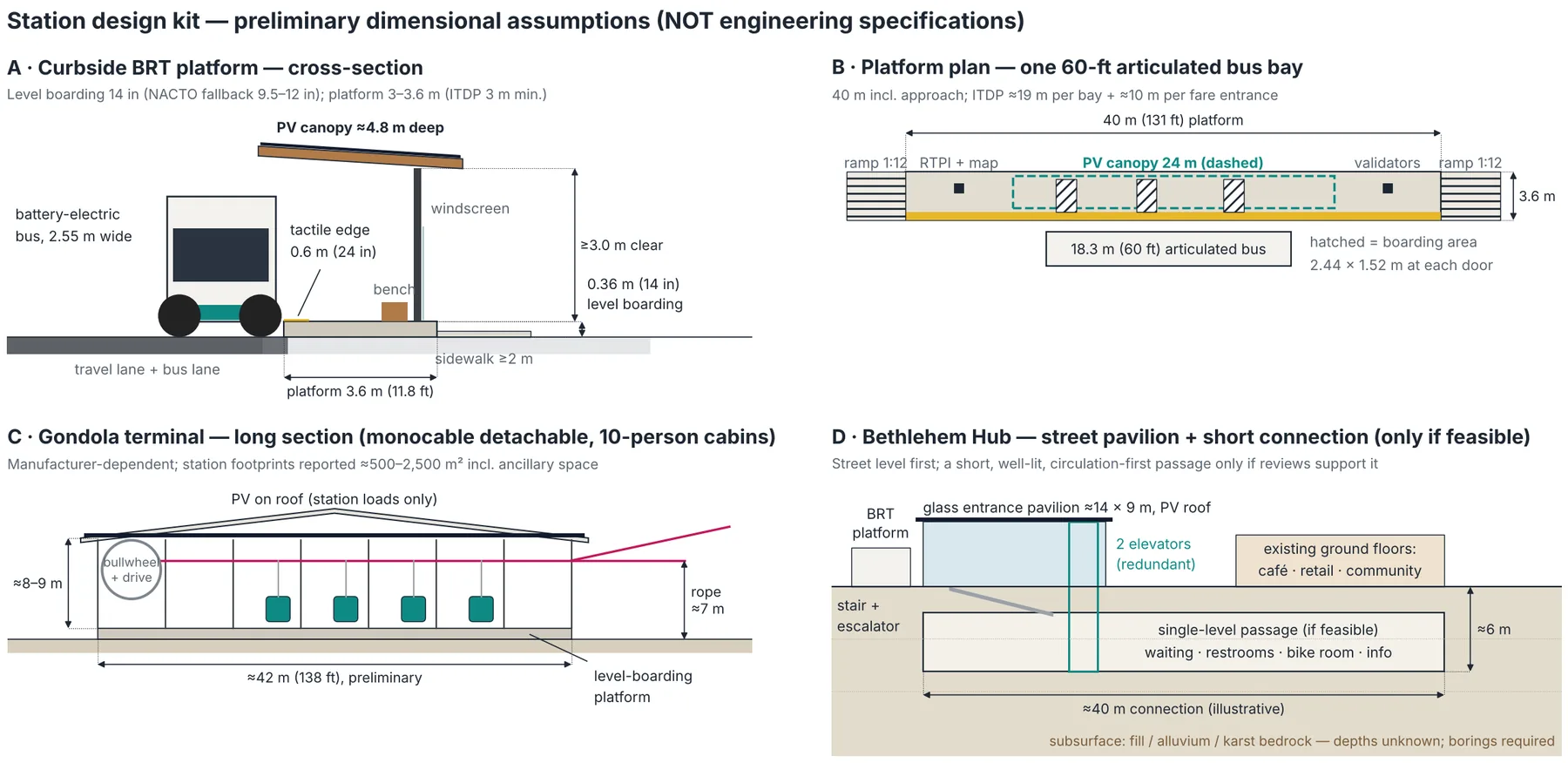
- Level or near-level boarding (about 14 in / 0.36 m platforms); a 24-in detectable warning edge; a clear 96 × 60 in boarding area at the front door.
- Seating at least every 60 m; shade and wind shelter; lighting, CCTV and a help point.
- Real-time arrivals in visual and audio form; consistent, multilingual and tactile wayfinding.
- Redundant elevators wherever there is a level change, with an outage plan (49 CFR 37.161).
- Bike parking; trail and sidewalk links; heated or snow-melt areas on the mountain.
- An accessible route on steep links such as University Center ↔ Farrington (~10% grade): bus stops at both ends, plus a lift link if a gondola terminal is ever built nearby.
Amenities by place
Affordable food
Lounges & study nooks
Gardens & native planting
Learning
Local retail
Recycle, compost, reuse
Sports
Stop by stop: worth it or not
Every stop gets the essentials below. Twenty-five extras were then rated at each of the 13 stops and evaluated destinations, using the measured data: walk-area activity, LANTA trips, elevation and exposure, events, whether the stop is a terminus, and what already exists nearby. Building what already exists next door is not worth it. These are the author's screening judgments, re-checked in a second internal pass (not an outside or professional review) — not designs, budgets or commitments.
Essentials at every stop
- Level boarding platform (about 14 in / 0.36 m high, ramps no steeper than 1:12)Lets wheelchairs, walkers, strollers, bikes and luggage roll straight on, and keeps stops short so 10-minute service stays reliable. Platform height must match the chosen bus (to confirm); bus ramps are still required.
- Detectable warning strip (24 in) along the platform edgeMarks the platform edge for blind and low-vision riders. Cheap when built in, costly to add later.
- Clear boarding area (96 x 60 in) and an accessible path to sidewalks, crossings and trailsLeaves room to deploy the bus ramp and turn a wheelchair; a stop is only accessible if the path to it is. Includes trail links at HEL and POLK. The ~10% slope between UC and FARR needs an alternative: a bus stop at each end.
- Shelter with roof, wind screens and a wheelchair space insideWeather protection is what riders use most, and winter wind matters at every stop. Low-profile and wire-free downtown. Flood-resilient fixings at POLK, and at PNR and HEL if Saucon Creek flood maps show exposure (to confirm).
- Seating about every 60 m, some with armrests, plus a leaning railHelps older riders, people with disabilities, and hospital and shift workers. Armrests and leaning rails are a proposed addition to the kit.
- Lighting on the platform and the paths to itKeeps stops safe and visible across the 18-hour day (about 6 a.m. to midnight), for shift workers and late event crowds.
- Cameras and a help point (two-way call with sound and light signals)Gives riders a way to get help at unstaffed stops; outside the Hub it is also the customer-service channel. Who watches the cameras is to confirm.
- Real-time arrival screens with push-to-hear audioEveryone can see, and blind riders can hear, when the next bus comes and which route it is. Needs a live data feed, LANTA's agreement (to confirm), and power and data at each stop.
- Pay before boarding: tap-to-pay readers, plus accessible fare machines wherever machines are installedLets riders board at every door and keeps stops short. The plan proposes one fare across LANTA and campus shuttles; whether LANTA can take tap-to-pay cards is to confirm.
- Clear signs and maps in several languages, with Braille and raised lettersStation name, route signs and a local map with walking times. At least English and Spanish, with the final set from a language-access study. One look across LANTA, Lehigh and Moravian.
- Bike racksExtends each stop's reach well beyond a 10-minute walk at very low cost. Keep racks out of the boarding area and walking path.
- Rain garden or native plantingHandles rainwater and adds shade. In the valley's sinkhole-prone carbonate (karst) ground, use lined or underdrained beds unless a soil check allows soaking in (to confirm per site).
- Spare conduit, power and data, plus room to lengthen the platformLets screens, heaters, cameras or a longer platform be added later without digging again. It keeps the upgrade path open: more frequent buses, longer buses, then rail on the valley corridor only if demand proves out. Reusing the kit on other Pennsylvania corridors is an aspiration, not a commitment by any agency.
- Upkeep and outage plan for accessible features, including snow and ice clearingAccessibility only counts when it works: screens, audio, help points, ramps and clear paths must be kept working, fixed fast, and backed up during outages. Could be tracked in Project OS, which is in development and not yet live.
- Sorting point for recycling, compost and trash, with clear signsKeeps stops clean at low cost and keeps recyclables out of landfill. Compost bins only where a compost collection option exists (to confirm with the hauler). Place them outside the boarding area and walking path.
Extras, stop by stop
Worth it Maybe later Not worth it
| Amenity | 1 I-78 Park & Ride | 2 Hellertown / Saucon Valley | 3 Goodman / Stabler Arena | 4 Mountaintop / Iacocca Hall | 5 Lehigh University Center | 6 Farrington Square | 7 Third St / SteelStacks | 8 Downtown / Broad Street | 9 Moravian University | 10 North Bethlehem | SL St. Luke's (Fountain Hill) | WC Wind Creek | NX Bethlehem Square / US 22 |
|---|---|---|---|---|---|---|---|---|---|---|---|---|---|
| Heated, enclosed waiting room | Maybe later: Valley site with 10-minute service, so waits are short. Add a room only if intercity bays bring long waits (carriers to confirm). | Not worth it: Valley through stop at 86.7 m with 10-minute service (about a 5-minute wait). A wind-screened shelter is enough. | Maybe later: A through stop at 95.5 m needs only a wind-screened shelter; an enclosed room comes only inside a gondola terminal, if built. | Worth it: Colder and windier 180 m above Goodman; the plan proposes one. Needs a winter service plan and a Lehigh agreement (to confirm). | Maybe later: Below the ~200 m exposure test with ~5-minute waits; an enclosed room only inside a gondola terminal, if one is built nearby. | Not worth it: Valley stop with 10-minute service on both lines and timed transfers, so waits stay short. Wind-screened shelters are enough. | Not worth it: Ground is 0.5-1.9 m below the 1942 crest (indicative): no ground-level room. Most Green Line transfers aren't timed, so heaters are required. | Worth it: Transfers to ~30-minute EBS and intercity buses mean 10+ minute waits. Check the BTC's indoor waiting first, then fill gaps. | Not worth it: Through stop with 10-minute service (about a 5-minute wait); a wind-screened shelter, optionally with an on-demand heater, is enough. | Not worth it: Buses every 10 minutes and no infrequent transfers mean about 5-minute waits; a wind-screened shelter, optionally heated, is enough. | Not worth it: About 101 m and not exposed; the lobbies at Entrances A and B are steps away, if St. Luke's agrees (to confirm). | Not worth it: No station exists or is proposed now; riders use the EBS Green Line terminus. An extension would still mean ~5-minute waits. | Not worth it: No station exists yet, and at 112.4 m it isn't exposed; a wind-screened shelter suits a 10-minute terminus. |
| Public restrooms | Maybe later: Low use near the proxy point (55 places, 18 trips). Revisit if intercity bays come; check the reported Turkey Hill store first. | Not worth it: Low-use through stop with only 34 LANTA trips and short waits. | Not worth it: Very low everyday use. On event days, seek rider access to venue restrooms by Lehigh agreement; temporary units only if needed. | Not worth it: Low use (57 places, 0 trips). Point riders to Iacocca Hall restrooms by agreement (distance, access and hours to confirm). | Not worth it: The Clayton University Center is next door (public access and hours to confirm), and only 16 LANTA trips run nearby. | Not worth it: Busy, but a through junction with timed transfers rather than long waits, and no cleaning budget is identified. | Not worth it: No permanent building on flood-exposed ground. On event days, check nearby venue or garage restrooms first, then temporary units. | Worth it: Busiest stop (725 places, 360 trips) with intercity riders. Check the BTC first, and fund cleaning and security (to confirm). | Not worth it: Low use (41 trips) and no long transfer waits at this through stop. | Not worth it: Below the use test (281 places, 30 trips) with no long waits; driver restrooms are covered separately. | Not worth it: Hospital lobby restrooms are next to the stop (public access and hours to confirm), and use is modest (192 places, 54 trips). | Not worth it: No Connect station now; seek rider access at the 24/7 Wind Creek complex by agreement (to confirm) instead of building. | Not worth it: No station and no measured walkshed yet; check what nearby retail already offers (to confirm) before ever building. |
| Staffed customer service | Not worth it: Only 18 LANTA trips near the proxy point, so the help point and real-time screens are enough. | Not worth it: Only 34 trips at a through stop, so the help point and real-time screens are enough. | Not worth it: Events are occasional, so use temporary event-day ambassadors rather than permanent staff. | Not worth it: 0 LANTA trips at a through stop, so the help point and real-time screens are enough. | Not worth it: Only 16 LANTA trips and no intercity service, so the help point and real-time screens are enough. | Not worth it: 264 trips is under the 300 bar and there is no intercity service. The student-services kiosk is a partner idea. | Not worth it: 202 trips is under the 300 bar; use temporary ambassadors on Musikfest and other big event days. | Worth it: Only stop with 300+ trips plus intercity links. Share any existing LANTA window at the BTC rather than open another. | Not worth it: Light use (41 trips), so the help point and real-time screens are enough. | Not worth it: Light use (30 trips) and no intercity links, so the help point and real-time screens are enough. | Not worth it: Only 54 LANTA trips and no intercity links; the help point and real-time screens are enough. | Not worth it: 220 LANTA trips is below the 300 test, and this isn't the main hub; the help point is enough. | Not worth it: Not the main hub, with no measured trips or intercity links. |
| Secure bike lockers or bike hub, and bike-share docks | Worth it: A terminus and park-and-ride where the plan proposes bike lockers. No bike-share docks until an operator exists. | Worth it: The Saucon Rail Trail is about 230 m straight-line in the project's trail map (walk to confirm). Racks plus a few lockers. | Not worth it: Tiny walkshed (36 buildings) and an 11% climb to Mountaintop, so carry bikes on bus racks instead. | Not worth it: Only 12 buildings in the walkshed and 11-13% climbs, so carry bikes on bus racks. | Maybe later: Not a terminus, junction or trail stop, so racks first. E-bike share docks only once an operator commits (none confirmed). | Worth it: Line junction where the plan proposes a bike hub; the Greenway is ~170 m straight-line. Bike share only once an operator exists. | Worth it: River Line terminus about 90 m from the Greenway: lockers inside the Polk St Garage above flood level by agreement, racks outside. | Worth it: Secure lockers suit the main hub. Bike-share docks wait until an operator exists; none is confirmed in Bethlehem. | Maybe later: Not a terminus, junction or trail stop, so racks first. E-bike share only if an operator commits; lockers only if racks fill. | Worth it: A terminus with the largest walkshed (2,002 buildings), so secure lockers extend its reach. Bike share only once an operator exists. | Maybe later: Bike share fails (192 places, no operator) and the branch climbs 10.5%. Lockers only if staff data show bike commuters. | Maybe later: Lockers only if the River Line extends here; the Greenway is ~120 m straight-line. Bike share fails (76 places, no operator). | Maybe later: Lockers only if the extension is built as a terminus or park-and-ride; bike share needs a measured walkshed and an operator. |
| Park-and-ride | Worth it: Network edge at I-78 with a thin walkshed. Share the reported lot by agreement instead of building spaces (site, owner to confirm). | Not worth it: Walkable town core (1,750 buildings, 227 places), and the I-78 P&R is the next stop south. | Not worth it: On Lehigh land and Lehigh hasn't proposed one. Event drivers can use the I-78 P&R or Polk St Garage by agreement. | Not worth it: Hilltop Lehigh land with no highway interchange, and Lehigh hasn't proposed one. | Not worth it: Walkable campus core (620 buildings, 256 places) on Lehigh land, where parking would push out campus uses. | Not worth it: Dense Southside core (656 buildings, 524 places), where parking would push out shops and platform space. | Not worth it: The Polk St Garage (731 spaces) is already here; use it for event parking by owner agreement, with no new spaces. | Not worth it: Densest walkable core (725 places, 1,374 buildings); a parking lot would push out shops, homes or platform space. | Not worth it: Walkable campus area (1,279 buildings, 214 places) far from any highway interchange. | Not worth it: Walkable neighborhood with no highway interchange; a park-and-ride fits Bethlehem Square only if that extension is built. | Not worth it: Not at a highway edge, and the Entrance B parking deck already exists; the aim is staff-parking relief, not more parking. | Not worth it: Not at a highway interchange (I-78 is about 3 km south), and PNR already does that job. | Maybe later: Network edge near US 22, but only if the extension is built, sharing retail lots by agreement, after measuring the walkshed. |
| Drop-off and paratransit loading zone | Worth it: Riders arrive by car at the terminus; a cheap accessible drop-off and paratransit bay can sit off the bus platform. | Not worth it: The Main St curb is needed for the platform. Use legal loading on a side street within ~50 m, with the Borough. | Worth it: Game and concert days bring pick-up and rideshare demand; a cheap accessible loading zone can sit off the platform (Lehigh to confirm). | Not worth it: Tiny walkshed with no hub, hospital or event role; occasional pick-ups and AccessLU can use campus curbs (to confirm). | Not worth it: The curb is needed for the platform; use legal loading on a side street within ~50 m. Lehigh's AccessLU already exists. | Not worth it: The New St curb is needed for junction platforms and possible bus lanes; use legal side-street loading within ~50 m. | Worth it: SteelStacks and Musikfest bring rideshare and pick-up demand; a cheap loading zone off the platform helps (space to confirm). | Worth it: Paratransit and car pick-ups meet transfers near the BTC; put the accessible loading zone on a side street, not the bus curb. | Not worth it: The Main St curb is needed for the platform; use legal loading on a side street within ~50 m. | Worth it: A terminus by Liberty High School (~2,485 students) draws pick-ups and paratransit; keep it apart from school-bus loading. | Worth it: If the branch is built, use the hospital's existing drop-offs at Entrances A and B by agreement, clear of ambulance routes. | Maybe later: Only if the River Line extends here; share existing Wind Creek curb space by agreement (to confirm) instead of a new bay. | Maybe later: A terminus would justify an accessible loading zone, but only if built; use existing retail curb space by agreement. |
| Terminal bus charger (overhead pantograph) | Worth it: South terminus with 5-minute layovers on an 89.6-minute cycle. Energy model, grid capacity and Saucon Creek flood siting to confirm. | Maybe later: Not needed at a through stop with ~25 s dwells, unless the PNR site fails and HEL becomes the fallback terminus. | Maybe later: Ordinary trips pass through. An event-layover charger is only an option, pending layover patterns, the energy model and grid capacity. | Not worth it: Through stop with ~20 s dwells; the energy plan shows no charger here, and buses regenerate on the descents. | Not worth it: Buses stop only ~25 s, and the energy plan puts no charger at stop 5. | Maybe later: ~25 s dwells in Phase 1. Revisit only if the Valley Express option ends here and depot charging falls short. | Maybe later: River Line terminus with 5-minute layovers, but depot charging may cover its 21.5-minute cycle (to confirm). Equipment above flood level. | Not worth it: Spine dwells are 20-25 s, depot charging may cover the River Line (to confirm), and overhead chargers don't fit the historic setting. | Not worth it: Through stop with a 20-25 s dwell; buses would charge at the proposed NBETH terminal, 0.92 km on (site TBD). | Worth it: Spine buses lay over 5 minutes here, and the plan proposes a terminal pantograph. Site, energy model and grid capacity to confirm. | Not worth it: The branch is short (1.67-2.30 km), so a large charger on Ostrum St near ambulance routes isn't justified (model to confirm). | Maybe later: An extended River Line would lay over here; build one only if depot charging falls short and grid capacity exists (to confirm). | Maybe later: If extended, BSQ becomes the northern terminus; re-run the energy model and pick one northern charger site, here or NBETH. |
| Solar panels on the station canopy | Worth it: Open site with no known heritage limit. Counts as yearly energy equivalence, not direct bus power; carport waits on lot ownership. | Worth it: The energy plan puts solar on the standard canopy, cheaper at build time than later. Shading and crediting account to confirm. | Maybe later: Canopy solar is proposed, but solar on Lehigh land can't simply credit a City or LANTA account (agreement to confirm). | Maybe later: Canopy and pavilion-roof solar are proposed, but solar on Lehigh land can't simply credit a City or LANTA account (to confirm). | Maybe later: A canopy is proposed, but the stop is on Lehigh campus roads, and Lehigh-land solar can't simply credit City or LANTA accounts. | Worth it: The energy plan gives stop 6 a canopy. Check New St shading, crediting, and HCC review if in the conservation district. | Worth it: Canopy in the energy plan; inverters above flood level, heritage views kept clear, HCC review if in the conservation district. | Maybe later: Heritage review (HARB, Section 106) may allow only low-profile panels, or none. | Worth it: The standard canopy gets solar under the energy plan; shading and an account to take the credits are to confirm. | Worth it: Standard canopy solar under the energy plan; no heritage review is identified (to confirm). Shading and crediting to confirm. | Maybe later: A canopy is the default, but shading and which account could take credits on Ostrum St are unknown (to confirm). | Maybe later: Only once a station exists; shading, site ownership and crediting account are unknown (to confirm). | Maybe later: A shared retail lot isn't project land, so only if an account can take the credits (to confirm). No large carport here. |
| Battery energy storage | Maybe later: Could trim terminal charger peaks, but only if demand charges (not yet pulled) justify it. Site above Saucon Creek flood level. | Not worth it: Open-air through stop with only lights, screens and a help point; a small UPS covers communications. | Maybe later: Only to trim peaks if the optional event charger is built. | Maybe later: The energy plan ties it to gondola life-safety, so it waits for the gondola or pavilion; a small UPS covers the room. | Not worth it: Open-air through stop; a small UPS covers lights, screens and the help point. | Not worth it: Open-air through stop; a small UPS covers the screens and help points. | Maybe later: For now a small UPS above flood level covers lights and screens; a battery only with an event-critical space above flood level. | Maybe later: Only once an enclosed Hub space is secured; then size it for life-safety and communications backup, not for running buses. | Not worth it: Open-air stop with only lights, screens and a help point; a small UPS covers communications. | Maybe later: Would pair with the terminal charger, but only if demand charges or grid limits make peak trimming pay (values not pulled). | Not worth it: Open-air stop with no charger; a small UPS covers lights, screens and the help point. | Maybe later: Only if a terminal charger is built here and demand charges (not yet pulled) make peak trimming pay. | Maybe later: Only if the northern terminal charger is built here and demand charges (still to be pulled) make peak trimming pay. |
| Food or coffee kiosk (partner-run) | Not worth it: Footfall near the proxy point (55 places, 18 trips) is far below 500/200. Point riders to the reported Turkey Hill store. | Not worth it: Below the 500/200 test (227 places, 34 trips), and it would compete with Main St shops. Point riders to them. | Not worth it: Too few everyday users for a kiosk; partner-run team food pickup on league or event days only. | Not worth it: Low footfall: 57 places and 0 LANTA trips. | Not worth it: The Clayton University Center already has dining, and 256 places and 16 trips fail the 500/200 test. | Maybe later: Passes the footfall test (524 places, 264 trips) and the plan proposes food partners, but none exists yet. Check existing shops first. | Maybe later: Just passes the footfall test (511 places, 202 trips). Event-day pop-ups for now; a permanent kiosk needs a partner. | Maybe later: Footfall passes (725 places, 360 trips), but it needs a partner and no cafe already facing the platform within ~100 m. | Not worth it: Below the footfall test (214 places, 41 trips), and it would compete with Main St businesses; point riders to them. | Not worth it: Below the footfall test (281 places, 30 trips). | Not worth it: Fails the footfall test: 192 places and 54 trips, against 500 and 200. | Not worth it: 220 trips, but only 76 places, far below the 500 test. | Not worth it: Already a retail destination, so a kiosk would compete with existing shops; the walkshed isn't measured either. |
| Small shop space | Not worth it: Low footfall and no existing ground floor facing the platform. New standalone retail is never worth it. | Not worth it: Below the footfall test, and it would duplicate the Main St shops next to the stop. | Not worth it: Very low footfall (17 places) and no existing ground floor facing the platform. | Not worth it: Low footfall and no existing ground floor facing the platform. | Not worth it: Below the 500/200 test, and shops would duplicate the Clayton University Center. | Maybe later: Footfall passes, but only in an existing street-level ground floor facing the platform that can be leased (to confirm). | Maybe later: Footfall passes, but only in an existing street-level ground floor that can be leased (to confirm). Never below grade here. | Maybe later: Only in an existing street-level ground floor that can be leased (to confirm) and doesn't copy Main St shops. | Not worth it: Too few people pass (214 places, 41 trips) to support a tenant. | Not worth it: Too few people pass (281 places, 30 trips) to support a tenant. | Not worth it: Below the footfall test, and new standalone retail is ruled out. | Not worth it: 76 places is far below the 500 test, and there's no station. | Not worth it: New retail would duplicate the shops already next door. |
| Community lounge or study nook | Not worth it: A park-and-ride terminus with no host partner is the wrong place for a lounge. | Not worth it: Open-air platform with no host partner. | Not worth it: Open-air stop with no host; a study nook fits better at the Asa Packer end if a gondola terminal is built. | Not worth it: No host partner and a tiny walkshed, and the proposed geology pavilion already covers the learning role. | Maybe later: The plan proposes a study nook, but it needs an enclosed space and Lehigh as host, without duplicating Clayton UC space. | Maybe later: The plan lists a study nook here, but there is no enclosed space or host yet, and it shouldn't duplicate campus lounges. | Not worth it: Open-air transfer platform with no enclosed space or host; the plan puts lounges at Downtown, Farrington and a gondola terminal. | Maybe later: The Hub idea includes community space, but it needs a secured ground floor and a host such as a library. Neither exists. | Not worth it: Open-air stop with no host; revisit only if Moravian proposes one. | Not worth it: Open-air terminus with no host for a lounge. | Not worth it: Curbside stop with no enclosed space or host, outside the plan's student and civic catchments. | Not worth it: No enclosed space, no host partner, and not a student or civic catchment. | Not worth it: A park-and-ride or terminus stop with no host partner. |
| Equipment-lending lockers or package lockers | Maybe later: No venue for lending lockers, but package lockers could suit a P&R terminus if a vendor installs them free (to confirm). | Maybe later: 1,750 buildings passes the package-locker test, but only if Main St space allows and a vendor installs them free (to confirm). | Maybe later: Goodman fields are 247 m away, but lending lockers need a partner to manage gear. Lehigh Leagues is not a Lehigh program. | Not worth it: No recreation venue within ~250 m in the files, and 12 buildings is far below the 1,000 for package lockers. | Not worth it: Tight campus platform; Grace Hall and Taylor Gym are 321 m away with no partner, and 620 buildings is under 1,000. | Not worth it: Tight New St platforms, no recreation partner within 250 m, and 656 buildings is under the 1,000 package-locker bar. | Not worth it: Ground-level lockers on flood-exposed ground are ruled out, no lending partner exists, and 760 buildings is under 1,000. | Not worth it: Tight curb in the historic setting, no recreation venue nearby, and no partner to manage lockers. | Maybe later: 1,279 buildings meets the package-locker test, but only with room off the walking path and a vendor installing them free. | Maybe later: 2,002 buildings at a terminus meets the package-locker test, if a vendor installs them free and the layover site has room. | Maybe later: 1,318 buildings clears the package-locker test, but only if the branch is built, Ostrum St has room and a vendor installs free. | Not worth it: 240 buildings is far below the 1,000 package-locker test, and no recreation venue or partner is identified. | Maybe later: Package lockers could suit a terminus or park-and-ride if a vendor installs them free (to confirm); no venue for lending lockers. |
| Water bottle filler | Maybe later: Only if intercity bays bring long waits and a water line already reaches an on-site building (to confirm). | Maybe later: Useful for trail users only if an adjacent building's tap can be shared by agreement; a new freeze-proof line isn't worth it. | Maybe later: Event crowds would use one, but only if a nearby Lehigh building or gondola terminal tap can serve it (to confirm). | Maybe later: An outdoor filler would freeze at 275 m; add one inside the heated room only if a water line reaches it. | Not worth it: Open-air through stop with short waits and no trail or event crowds; a new freeze-proof water line costs more than it gives. | Not worth it: Open-air junction with short timed waits; a new freeze-proof water line isn't justified unless a nearby building's tap can be shared. | Maybe later: Greenway users and Musikfest crowds would use one, but only if existing water reaches the stop (to confirm), freeze-protected. | Worth it: Indoors in the Hub, sharing the restrooms' water supply, for riders waiting on 30-minute and intercity buses. Check the BTC first. | Not worth it: An open-air through stop would need a new water line and freeze protection, with no trail, event or long-wait need. | Not worth it: No trail, event crowd or long wait here, so a new water line with freeze protection costs more than it gives. | Not worth it: No trail users or event crowds, so a new freeze-proof water line isn't justified. | Not worth it: No Connect station now, so a new freeze-proof water line at LANTA's existing terminus isn't justified. | Not worth it: No known water service, trail, events or long waits here. |
| Event queuing and bus staging space | Not worth it: No large venue nearby. Event parking would use the reported lot by owner agreement, with no corrals built. | Not worth it: No venue of 5,000+ capacity within a 10-minute walk. | Worth it: Size bays for typical games (~5,000; 8-12 trips/hour). For sellouts and commencement (24-36 trips/hour), use temporary staging by Lehigh agreement. | Not worth it: No venue of 5,000+ capacity within a 10-minute walk. | Not worth it: No documented 5,000+ venue within a 10-minute walk; big crowds are planned at GOOD, POLK and FARR. | Worth it: The plan stages surge buses here on move-in, commencement and game days; reserve curb space for temporary staging and queue lanes. | Worth it: Musikfest drew 23,811 cross-river rides in 2025, and Christkindlmarkt brings winter crowds. Plan temporary, lit, heated queue space nearby. | Worth it: Musikfest's downtown venues and the north end of cross-river rides need temporary queue space in the event plan (to confirm). | Not worth it: No 5,000-seat venue or major festival site is identified near this stop. | Not worth it: Liberty High School peaks are handled with extra trips at bell times, not queue corrals. | Not worth it: No venue of about 5,000+ within a 10-minute walk; shift changes are handled with timed trips. | Not worth it: The Wind Creek Event Center (about 2,250–2,550 seated, up to about 3,800 standing; leads, discoverlehighvalley.com, retrieved 19 Oct 2026) and the 2,000-person ballroom are both below the ~5,000 test; Wind Creek events stay with the existing Green Line terminus. | Not worth it: No venue of about 5,000 seats or major festival is identified nearby. |
| Elevators (in pairs), only at level changes | Not worth it: Curbside platform with no level change; ramps handle the 0.36 m rise. | Not worth it: Curbside platform with no level change, so ramps are enough. | Maybe later: Only if a raised gondola terminal is built; the curbside bus platform uses ramps. | Maybe later: Only if a raised gondola angle station is built; the bus platform uses ramps. | Maybe later: Not for the curbside stop (ramps). Only with a gondola terminal near UC: redundant elevators and a lift link to Farrington. | Not worth it: Curbside platforms where grading or ramps handle the 0.36 m rise; a lift link to UC applies only with a gondola terminal. | Not worth it: The curbside platform on E 3rd St has no level change; grading handles the 0.36 m rise. | Maybe later: Not for the curbside platform (ramps). Redundant elevators only if a below-grade link passes geotechnical, safety, heritage and finance reviews. | Not worth it: Curbside platform with no level change; ramps handle the rise. | Not worth it: Curbside platform with no level change; ramps handle the rise. | Not worth it: Curbside Ostrum St stop; sidewalk grading or ramps handle the 0.36 m rise. | Not worth it: Any future stop would be curbside on Wind Creek Blvd, with no level change. | Not worth it: Any future stop would be curbside or lot-side with no level change. |
| Ground-source heat pumps (enclosed spaces only) | Not worth it: No enclosed space is planned, and the valley's carbonate ground would need karst screening. | Not worth it: Open-air shelter with no enclosed space to heat. | Maybe later: Only for the optional gondola terminal, after karst screening of the carbonate-geology overlay. | Maybe later: Gneiss is favorable and a heated room is planned, but borehole land on campus isn't agreed; air-source heat pumps are the fallback. | Maybe later: Only inside a gondola terminal near UC, if built, after a geology and karst check; the bus stop itself is open-air. | Not worth it: Only open-air shelters here, and the valley's carbonate ground would need karst screening. | Not worth it: No enclosed space to heat, plus flood exposure and karst ground. | Maybe later: Needs an enclosed Hub space, karst screening and borehole room in the historic core; air-source heat pumps may be more practical. | Not worth it: Open-air shelter with nothing enclosed to heat. | Not worth it: Open-air shelter with nothing enclosed to heat. | Not worth it: No enclosed space is planned; riders would use the hospital lobbies. | Not worth it: No enclosed space is planned. | Not worth it: No enclosed space is planned. |
| Public art and heritage or geology display | Not worth it: No documented heritage or geology at the site in the project files. Art built into windscreens or paving stays optional. | Maybe later: The Great Unconformity sign on the Saucon Rail Trail at Landis Mill Rd could be a panel subject; distance to confirm. | Not worth it: No documented heritage or geology at the stop in the project files. Art built into windscreens or paving stays optional. | Worth it: Documented geology (Great Unconformity, sauconite) suits the proposed pavilion; its exact site and Lehigh's agreement are to confirm. Loaned specimens only. | Maybe later: Hardyston quartzite from local quarries appears in Lehigh buildings, so a small sourced panel is possible with Lehigh's input (to confirm). | Maybe later: No sourced display content yet; a panel only if the stop is inside the South Bethlehem Downtown Historic District (to confirm). | Worth it: Views to the blast furnaces and Hoover-Mason Trestle, and NMIH 424 m away, give real content. The museum has agreed to nothing. | Worth it: Downtown is the setting of the UNESCO Moravian Church Settlements (2024); sourced, low-profile content fits after HARB and Section 106 review. | Maybe later: Hardyston quartzite appears in Moravian buildings, but a display needs sourced content and Moravian's interest (to confirm). | Not worth it: No documented heritage or geology at Linden & Elizabeth in the project files. Built-in art stays optional. | Not worth it: No documented heritage or geology tied to this stop in the project files. Built-in art stays optional. | Not worth it: No station now and no documented display content; Greenway wayfinding is the Phase 1 action. | Not worth it: No documented heritage or geology tied to this stop in the project files. |
| Snow-melt at the platform edge | Not worth it: Valley site at 83.7 m on gentle grades (max 4.3% to Hellertown), so the snow and ice plan covers it. | Not worth it: Valley stop at 86.7 m on gentle grades (max 4.3%), so the snow and ice plan covers it. | Not worth it: Valley stop at 95.5 m; rely on the snow and ice plan, and revisit if a measured walking approach exceeds ~8%. | Worth it: At 275.4 m with 11-13% approaches, ice would block the accessible route; the plan proposes snow-melt at the platform edge. | Maybe later: The 0.86 km link down to Farrington reaches about 10%, above the ~8% test; measure the walking approach before heating anything. | Maybe later: Valley stop at 82.8 m, but it shares the ~10% slope up to UC; measure the walking approach before heating anything. | Not worth it: Valley stop at 71.7 m on gentle grades (max 5.2%), so the snow and ice plan covers it. | Not worth it: Valley stop at 103.7 m; rely on the snow and ice plan, and revisit if a measured walking approach exceeds ~8%. | Not worth it: Valley stop at 94.3 m; the 8.4% grade is on the bus route, not a measured walk. Revisit above ~8%. | Not worth it: Valley stop at 103.0 m on a gentle approach (max 5.7% from Moravian), so the snow and ice plan covers it. | Not worth it: Valley stop at about 101 m; the 10.5% is the bus route. Revisit if a measured walking approach exceeds ~8%. | Not worth it: Valley stop at 78.5 m on gentle grades (max 5.2%); rely on snow clearing. | Not worth it: At 112.4 m it's a valley-level stop, far below the ~200 m test; rely on snow clearing. |
| Driver restroom and break room | Worth it: South terminus with 5-minute layovers over an 18-hour day. Use an existing building by agreement, above flood level (to confirm). | Maybe later: Not needed at a through stop; a must only if HEL becomes the fallback terminus because the PNR site can't be confirmed. | Worth it: Surge buses lay over here on game, concert and commencement days. Use a Lehigh venue building by agreement, or temporary units. | Not worth it: A through stop with no layover. | Not worth it: Buses only pass through; layovers would be at the proposed PNR and NBETH termini. | Maybe later: A through stop in Phase 1; if the Valley Express option ends here, arrange relief space in an existing building. | Worth it: River Line terminus with 5-minute layovers over 18 hours, so drivers need a restroom from day one, above flood level. | Worth it: The River Line turns here with 5-minute layovers over 18 hours. Use the BTC or Hub space by agreement (to confirm). | Not worth it: A through stop; drivers would take breaks at the proposed NBETH layover, 0.92 km on. | Worth it: Drivers lay over here every trip across an 18-hour day, so they need a restroom from day one; use a nearby building. | Maybe later: Only if branch buses lay over at the hospital, which isn't set; then use a hospital building by agreement (to confirm). | Maybe later: Needed from day one only if the River Line is extended to lay over here; use a Wind Creek building by agreement. | Maybe later: If extended, this becomes the northern terminus and relief is needed from day one; use an existing building by agreement. |
| Regional and intercity bus bays | Maybe later: LANTA Route 105 already serves a Hellertown P&R stop, but no intercity carrier has agreed. Reserve space; build only with agreement. | Not worth it: No regional or intercity carrier stops here; Route 105's P&R stop is at PNR. | Not worth it: No regional or intercity carrier stops here. | Not worth it: No regional or intercity carrier serves the campus hilltop. | Not worth it: No regional or intercity carrier stops here; they use the BTC downtown and the bays proposed at PNR. | Not worth it: No regional or intercity carrier stops here; they use the BTC downtown. | Not worth it: No intercity carrier stops here; Trans-Bridge uses the BTC and Wind Creek, and EBS already stops at SouthSide Station. | Not worth it: No new bays: Trans-Bridge already stops at the BTC and Greyhound/FlixBus at 635 Guetter St. Link them with signs. | Not worth it: No regional or intercity carrier stops here; those connections are at the Downtown BTC. | Not worth it: No regional or intercity carrier stops here. | Not worth it: No regional or intercity carrier stops here or has committed to. | Not worth it: Trans-Bridge already runs Wind Creek to New York service; use its existing stop (location to confirm). No bays without agreement. | Not worth it: No regional or intercity carrier stop or commitment is recorded here. |
| Rail-ready space reservation | Worth it: On the protected rail-ready corridor: keep room for a 60-90 m platform and a clear future trackway. Low-cost reservation only. | Not worth it: Not on the protected rail-ready corridor; PNR, the nearest rail-ready stop, is 4.7 minutes away by bus. | Not worth it: Campus and event stop that isn't on the protected rail-ready corridor. | Not worth it: Not on the rail-ready list; a tunnel station under Iacocca Hall would be about 196 m deep. | Not worth it: Off the rail-ready corridor; Farrington, the nearest rail-ready stop, is an 834 m walk or 2.3-minute ride. | Worth it: On the protected rail-ready valley corridor: reserve room to lengthen the platform to 60-90 m and keep the trackway clear. | Worth it: On the protected rail-ready valley corridor: reserve platform length and keep the trackway clear. Space only; no rail now. | Not worth it: Not on the protected rail-ready corridor (FARR is 1,478 m away); the standard extendable platform keeps options open. | Not worth it: Not on the protected rail-ready corridor; FARR is 2,670 m away. | Not worth it: Not on the protected rail-ready corridor (FARR is 2,931 m away); keeping the Linden St extension open is a bus question. | Not worth it: Rail isn't recommended on the St. Luke's branch (about 10% grades), and SLUH isn't on the rail-ready list. | Worth it: On the protected rail-ready valley corridor (Valley Express route): keep trackway and platform room clear. Low-cost safeguarding only. | Not worth it: Not on the rail-ready corridor list (PNR, WIND, POLK, FARR). |
| Hospital and 24/7 shift-worker features | Not worth it: No 24/7 employer with about 2,000 staff within 400 m in the project files. | Not worth it: No 24/7 employer with about 2,000 staff within 400 m in the project files. | Not worth it: No 24/7 employer with about 2,000 staff within 400 m. | Not worth it: No 24/7 employer with about 2,000 staff within 400 m. | Not worth it: No 24/7 employer with 2,000+ staff within 400 m; St. Luke's would be reached from Farrington (branch option A). | Maybe later: St. Luke's is 1,594 m away, but branch option A would start here; shift-timed transfers only if that branch is chosen. | Maybe later: Wind Creek's 24/7 workforce transfers here to the Green Line; shift-timed late transfers depend on the Wind Creek test. | Maybe later: No 24/7 employer within 400 m, but St. Luke's branch option B would start here; then time Hub transfers to shifts. | Maybe later: LVH–Muhlenberg is a 3,412 m walk away; shift-timed transfers apply only if a Muhlenberg branch idea from here is added. | Not worth it: No 24/7 employer nearby; Liberty High School is a daytime school served by bell-time trips. | Worth it: 24/7 trauma campus clears the 2,000-staff test; Route 108 evening trips were cut in June 2026. Build only with hospital interest. | Worth it: 1,667 staff plus ~575 tenant staff work 24/7. Propose testing late-night and shift-change trips with Wind Creek and LANTA (interest to confirm). | Not worth it: No 24/7 employer of 2,000+ within 400 m; St. Luke's Anderson Campus is about a 7.5 km walk and not served. |
| Energy display with real solar and charging data | Maybe later: Likeliest site for real charger and solar data, but only once those systems exist and a host maintains the screen. | Not worth it: No charger and only canopy solar, and the open-air screen is needed for arrival times. | Not worth it: No transit charger unless the event option is built; Lehigh's 3.1 MWdc Goodman array is Lehigh's, not transit data. | Maybe later: Fits in the pavilion once real solar and heat-pump meters exist and a host maintains it. Never placeholder data. | Not worth it: No live solar or charger meters here, and the open-air screen is needed for arrivals. | Not worth it: No charger and no live solar data until a canopy exists; the junction screen is needed for arrivals. | Not worth it: No charger and no live solar data until a canopy is built; the screen is needed for arrivals and event information. | Maybe later: No charger here, and heritage review may limit solar; a Hub display only if real solar data exists. | Not worth it: Open-air stop with no charger and no host; the screen is needed for arrival times. | Maybe later: Real charger and solar meters are planned here, but only once built and someone maintains the display. Never placeholder data. | Not worth it: No solar or charger meters would exist here, and the screen is needed for arrivals. | Not worth it: No solar or charger meters exist or are planned here. | Not worth it: No solar or charger meters exist here. |
| Public Wi-Fi and phone charging | Maybe later: Only if PNR gets an enclosed waiting room, which depends on intercity bays (to confirm). | Not worth it: Open-air through stop with ~5-minute waits; real-time screens already cover the information need. | Not worth it: Open-air stop with ~5-minute waits and no enclosed room unless a gondola terminal is built. | Worth it: Low cost inside the proposed heated waiting room, where riders shelter from the cold. | Not worth it: Open-air through stop with ~5-minute waits; real-time screens already meet the information need. | Not worth it: Open-air junction with ~5-minute timed waits; real-time screens already cover the information need. | Not worth it: Open-air stop with 10-minute service; ground-level equipment would face flooding, and screens cover the information need. | Worth it: Riders wait longer inside the Hub for 30-minute and intercity buses; check what the BTC already offers and fill the gaps. | Not worth it: Open-air through stop with about 5-minute waits; real-time screens already meet the need. | Not worth it: Open-air terminus with about 5-minute waits; real-time screens already meet the need. | Not worth it: Open-air stop with no enclosed waiting room; real-time screens cover the information need. | Not worth it: No enclosed waiting room and no Connect station. | Not worth it: No enclosed waiting room is planned. |
Stop numbers: 1 I-78 P&R · 2 Hellertown · 3 Goodman · 4 Mountaintop / Iacocca Hall · 5 University Center · 6 Farrington · 7 Third St · 8 Downtown · 9 Moravian · 10 North Bethlehem · SL St. Luke's · WC Wind Creek · NX North expansion. Each station page lists every reason in full.
Bethlehem Hub — street level first
Start with a street-level hub: waiting room, restrooms, real-time information, local retail and community space in existing ground floors (local precedent: the Easton Intermodal Transportation Center, 2015).
A below-grade connection (about 6 m deep, single level) is considered only if geotechnical, fire-life-safety, heritage and financial reviews support it. Reusing existing below-grade structures should be checked first.
Grade-separated retail often struggles — 59% of Duluth's skywalk retail space was vacant in a fall 2025 survey — so shops belong at street level. Downtown is the setting of the UNESCO-listed Moravian Church Settlements (2024): wire-free vehicles and low-profile shelters.
No building or site for a hub has been identified, and ownership and feasibility have not been studied.
Mountaintop / Iacocca Hall: a station near the garden, and a geology space
Mountaintop Discovery Gardens is a separate, student-initiated garden idea for Lehigh's Mountaintop Campus. It is not sponsored or endorsed by Lehigh University, and it includes no transit or museum parts. A Spine stop (and a possible gondola angle station) nearby would be a separate transit decision that could make the garden easy to reach without a car. This plan does not assume the garden's design.
Geology learning pavilion at the station — separate from the garden; above ground or earth-sheltered, not a mined museum (which would add high cost plus egress, ventilation and fire-safety burdens), with an outdoor rock garden of local stone. Content would be documented facts only, for example:
- The “Great Unconformity”: ~1.1-billion-year-old Reading Prong gneiss beneath Cambrian Hardyston Quartzite, visible on the Saucon Rail Trail.
- Sauconite, a zinc clay mineral named for the Saucon Valley, first described from the Friedensville area.
- Iron to steel: Bethlehem Iron's first furnace (1863) and the Homer Research Laboratories on the Mountaintop site (1961).
No geological discoveries are claimed. Specimens only on loan with documented provenance.
Bethlehem Commons and Lehigh Leagues
Bethlehem Commons Separate project
Lehigh Leagues Separate project
How transit could support league days (proposals)
- Idea
- League-day trips
- How it would work
- Extra trips between stations and venues on tournament days
- Precedent
- Williamsport's free "Little League Express" during the 2026 Little League World Series
- What it needs
- A sponsor and an operator agreement
- Idea
- Ticket or roster card as fare
- How it would work
- Show a league ID or game ticket to ride
- Precedent
- LA Metro's Dodger Stadium Express is free with a game ticket
- What it needs
- A LANTA board decision and a payer
- Idea
- Youth passes
- How it would work
- Free or reduced fares for registered players
- Precedent
- Lehigh already pays LANTA per trip for rides with a Lehigh ID (to confirm details)
- What it needs
- A LANTA decision and likely a federal fare-equity review
- Idea
- Venues near stations
- How it would work
- Hold games where a stop already is
- Precedent
- Proposal: Bethlehem Commons by the River Line; Saucon Park and Monocacy Way near Spine stops
- What it needs
- Agreements with venue owners
Dig & Discover — a museum of what we find, if we find it
Main gallery: street level at Third Street / SteelStacks
Rock-core display at Mountaintop / Iacocca Hall
Optional below-grade gallery Downtown
What digging could realistically turn up
- Rock cores from engineering test borings — likely whenever stations, towers or bridges are designed (local dolomite, quartzite and gneiss).
- Industrial-era objects and fill — possible near the former Bethlehem Steel site.
- Colonial-era archaeology — possible near the Moravian World Heritage district and Monocacy Creek; needs early review by the State Historic Preservation Office.
- Human remains — never displayed; historic burial grounds are avoided.
- Phase 1 is mostly surface work (paving, curbs, shelters, utilities), so it would turn up little. Deeper digging comes only with long-term rail or tower foundations.
Who owns finds
- On land the Commonwealth owns or controls, finds belong to the Commonwealth and the Pennsylvania Historical and Museum Commission is in charge (37 Pa.C.S. §506).
- On private land, generally the landowner, unless an agreement says otherwise; donations are made by deed of gift (Pennsylvania guidance to confirm).
- Federally funded projects follow Section 106 historic review with Pennsylvania's State Historic Preservation Office, and curation standards where agreements require them.
- Engineering cores usually belong to the project owner or contractor (our judgment); contracts could require donation to the PA Geological Survey core library.
“Give back” principles (proposal)
- Free to see, if a host or funder covers display and catalog costs (none identified yet).
- Public finds stay public; never sold.
- Open data with care: photos and descriptions published, exact find locations withheld (Pennsylvania keeps archaeological site locations confidential).
- Donate cores to the PA Geological Survey library.
- Respect the dead: no display; reburial with descendant and Tribal input.
- Budget curation from day one; local partners and school programs first.
- A permanent museum only after real finds and partner agreements. First steps need no digging: a “Geology of the Line” web page and a pop-up display.
Precedents: London Crossrail archaeology exhibition (Museum of London Docklands, 2017); LA Metro D Line fossils (La Brea Tar Pits, 2019); New York Second Avenue Subway exhibit (2017). Legal framework: 37 Pa.C.S. §§506–511; NHPA Section 106 and 36 CFR 800; 36 CFR Part 79. Partners named here have not agreed to anything.
Event days and shift changes
Musikfest and SteelStacks
Sellout crowds
Wind Creek shifts
Event park-and-ride
Every amenity is conditional
Building specifications come later