Evaluated destination SL
St. Luke's University Hospital (Fountain Hill)
Planning phase. An independent plan; nothing is funded or built yet. What this means
Why here
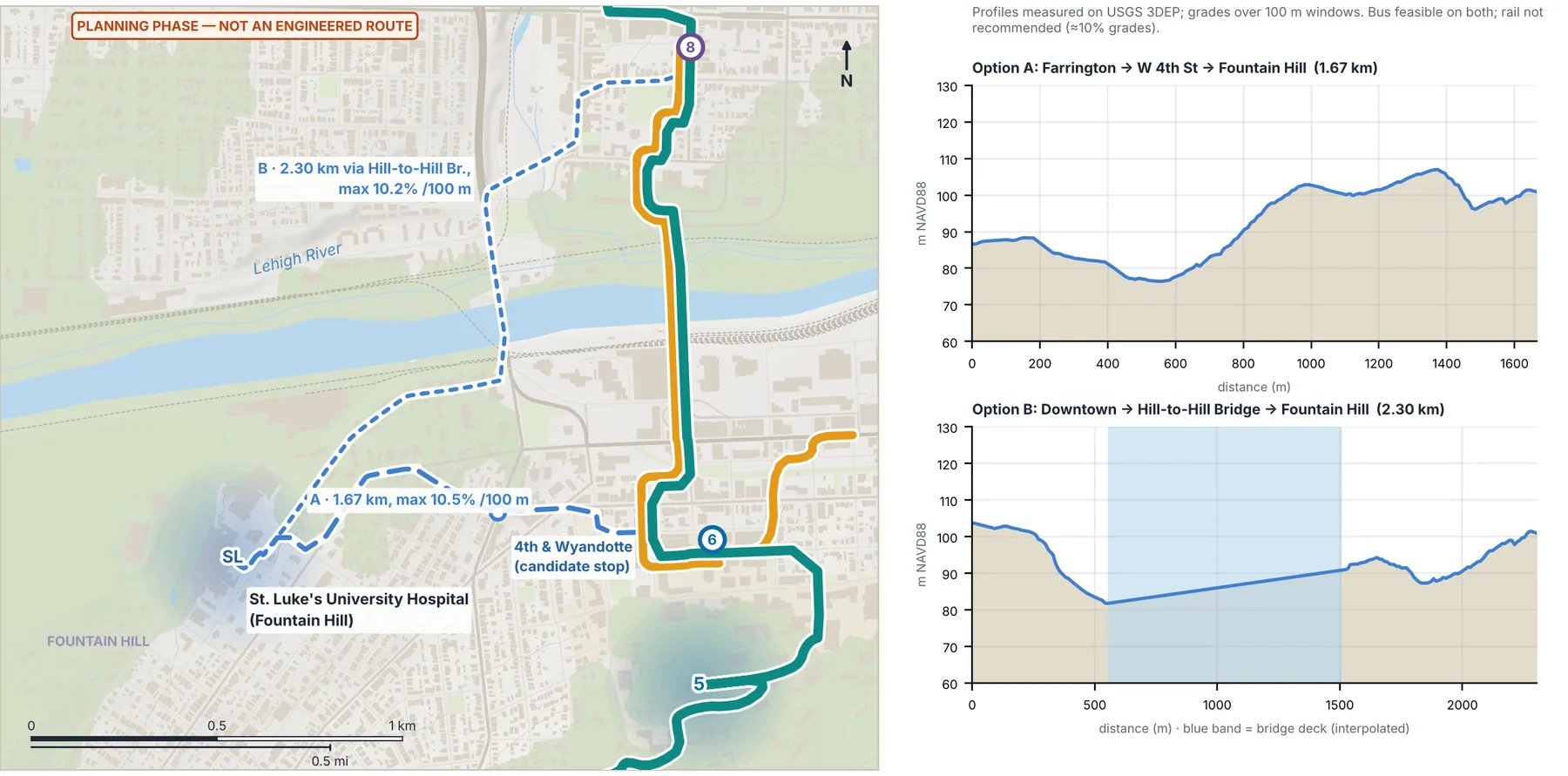
St. Luke's University Health Network's main campus, with 24/7 shifts and thin LANTA service. Option A from Farrington (1.67 km, max 10.5%) or option B from Downtown via the Hill-to-Hill Bridge (2.30 km, max 10.2%).
Program ideas Ideas if pursued · to study
- One Ostrum St stop between Entrances A and B
- Early-morning and late-evening trips matched to shifts
Which extras are worth it here, maybe later, or not worth it is rated further down this page.
What exists today Existing today
- LANTA Route 108 serves the area; its evening trips were cut in June 2026.
Measured station area
- Elevation
- 101 m (USGS 3DEP)
Future train access One Connect ride to a rail-ready stop
From St. Luke's (Fountain Hill), about 4 minutes on Bethlehem Connect to the rail-ready stop at Farrington Square.
No passenger trains run in Bethlehem today, and no regional rail route or station has been chosen. Rail-ready stops are where this plan would keep space free. How this was measured.
Measured links
- St. Luke's branch option A: Farrington Square → St. Luke's (Fountain Hill) · 1.67 km · ~3.8 min · max 10.5%
- St. Luke's branch option B: Downtown / Broad Street → St. Luke's (Fountain Hill) · 2.30 km · ~5.0 min · max 10.2%
Stop options on the way
- 4th & WyandotteA candidate stop on St. Luke's branch option A, 0.94 km from here along the branch.
Still unknown
- Emergency-department and ambulance access
- Ostrum St bus geometry
- Shift times and staff origins
- Hospital interest
Amenities here: worth it or not Screening judgment
Bus-branch test stop (a Phase 1 option) on Ostrum St at a 24/7 Level I trauma hospital (about 5,643 full-time personnel, scope to confirm) with a modest walkshed (192 places, 54 trips), where shift-worker and drop-off features are worth it if the branch is built and waiting space and restrooms should come from hospital lobbies by agreement.
Worth it here
- Drop-off and paratransit loading zone: If the branch is built, use the hospital's existing drop-offs at Entrances A and B by agreement, clear of ambulance routes.
- Hospital and 24/7 shift-worker features: 24/7 trauma campus clears the 2,000-staff test; Route 108 evening trips were cut in June 2026. Build only with hospital interest.
Maybe later here
- Secure bike lockers or bike hub, and bike-share docks: Bike share fails (192 places, no operator) and the branch climbs 10.5%. Lockers only if staff data show bike commuters.
- Solar panels on the station canopy: A canopy is the default, but shading and which account could take credits on Ostrum St are unknown (to confirm).
- Equipment-lending lockers or package lockers: 1,318 buildings clears the package-locker test, but only if the branch is built, Ostrum St has room and a vendor installs free.
- Driver restroom and break room: Only if branch buses lay over at the hospital, which isn't set; then use a hospital building by agreement (to confirm).
Not worth it here
- Heated, enclosed waiting room: About 101 m and not exposed; the lobbies at Entrances A and B are steps away, if St. Luke's agrees (to confirm).
- Public restrooms: Hospital lobby restrooms are next to the stop (public access and hours to confirm), and use is modest (192 places, 54 trips).
- Staffed customer service: Only 54 LANTA trips and no intercity links; the help point and real-time screens are enough.
- Park-and-ride: Not at a highway edge, and the Entrance B parking deck already exists; the aim is staff-parking relief, not more parking.
- Terminal bus charger (overhead pantograph): The branch is short (1.67-2.30 km), so a large charger on Ostrum St near ambulance routes isn't justified (model to confirm).
- Battery energy storage: Open-air stop with no charger; a small UPS covers lights, screens and the help point.
- Food or coffee kiosk (partner-run): Fails the footfall test: 192 places and 54 trips, against 500 and 200.
- Small shop space: Below the footfall test, and new standalone retail is ruled out.
- Community lounge or study nook: Curbside stop with no enclosed space or host, outside the plan's student and civic catchments.
- Water bottle filler: No trail users or event crowds, so a new freeze-proof water line isn't justified.
- Event queuing and bus staging space: No venue of about 5,000+ within a 10-minute walk; shift changes are handled with timed trips.
- Elevators (in pairs), only at level changes: Curbside Ostrum St stop; sidewalk grading or ramps handle the 0.36 m rise.
- Ground-source heat pumps (enclosed spaces only): No enclosed space is planned; riders would use the hospital lobbies.
- Public art and heritage or geology display: No documented heritage or geology tied to this stop in the project files. Built-in art stays optional.
- Snow-melt at the platform edge: Valley stop at about 101 m; the 10.5% is the bus route. Revisit if a measured walking approach exceeds ~8%.
- Regional and intercity bus bays: No regional or intercity carrier stops here or has committed to.
- Rail-ready space reservation: Rail isn't recommended on the St. Luke's branch (about 10% grades), and SLUH isn't on the rail-ready list.
- Energy display with real solar and charging data: No solar or charger meters would exist here, and the screen is needed for arrivals.
- Public Wi-Fi and phone charging: Open-air stop with no enclosed waiting room; real-time screens cover the information need.
Every stop also gets the essentials. Ratings are the author's screening judgment from measured data, not a design or a commitment.