Transportation Alternatives
Let the terrain choose the mode, corridor by corridor
Planning phase. An independent plan; nothing is funded or built yet. What this means
Screening summary
- Alternative
- A · Electric bus rapid transit
- Serves Mountaintop / Iacocca Hall?
- Yes, by bus on 11–13% grades
- Capital (Class 5)
- ~$45–215M BRT-lite; ~$320–880M with full dedicated lanes; plus fleet
- View
- Phase 1 · conditional target 2029
- Alternative
- B · Valley light rail + connector
- Serves Mountaintop / Iacocca Hall?
- No — needs a bus or gondola connector
- Capital (Class 5)
- ~$0.5–2.0B (plus bridge and connector)
- View
- Long-term idea
- Alternative
- C · Mixed surface / tunnel
- Serves Mountaintop / Iacocca Hall?
- No — a station would be ≈196 m deep
- Capital (Class 5)
- ~$0.8–3.4B; tunnel risk wider
- View
- Long-term comparison
- Alternative
- D · Underground automated metro
- Serves Mountaintop / Iacocca Hall?
- No
- Capital (Class 5)
- ~$1.6–6.4B; tunnel risk wider
- View
- Reference only
- Alternative
- X · Aerial gondola link
- Serves Mountaintop / Iacocca Hall?
- Yes — directly
- Capital (Class 5)
- ~$0.05–0.35B (low confidence)
- View
- Phase 1 option · conditional target 2029Only with a sponsor, land and a written regulatory path by about 2027; otherwise after 2030, if at all.
- Alternative
- Hybrid (A + X + valley option)
- Serves Mountaintop / Iacocca Hall?
- Yes
- Capital (Class 5)
- Staged — see Bethlehem 2030
- View
- Recommended for study
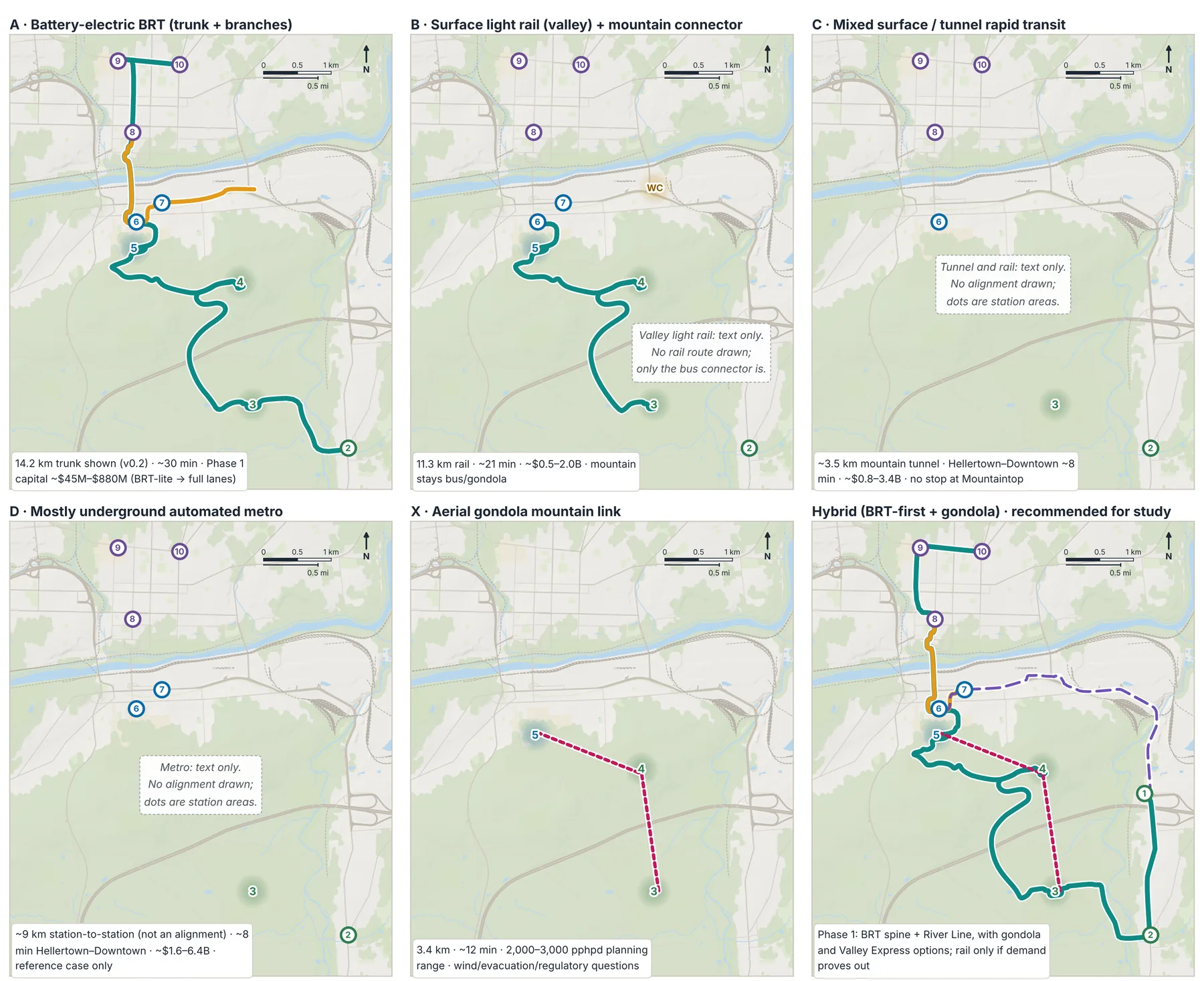
In-vehicle minutes from a kinematic model; excludes waiting, transfers and vertical access (deep stations in C and D add several minutes). A and X use the Phase 1 network; B–D are from the earlier screening.
- Trip
- Hellertown → Downtown
- A bus
- 24
- B light rail
- 16
- C tunnel
- 8
- D metro
- 8
- X gondola
- —
- Trip
- Goodman → University Center
- A bus
- 14
- B light rail
- —
- C tunnel
- —
- D metro
- —
- X gondola
- 12
- Trip
- Mountaintop / Iacocca Hall → University Center
- A bus
- 6.2
- B light rail
- —
- C tunnel
- —
- D metro
- —
- X gondola
- 6.0
- Trip
- Downtown → North Bethlehem
- A bus
- 5.7
- B light rail
- 5.3
- C tunnel
- 5.3
- D metro
- 3.1
- X gondola
- —
Which mode fits which corridor
- Corridor
- South approach
- Measured
- I-78 P&R–Hellertown–Goodman · 4.3 km · max 4.3%
- Electric BRT
- ✔✔ near-term
- Gondola
- ✖ no terrain need
- Surface light rail
- ○ via valley, long-term
- Tunnel / subway
- ✖
- Corridor
- Mountain link
- Measured
- Goodman – Mountaintop / Iacocca Hall – Asa Packer · bus 7.2 km, max 13.2% · gondola 3.4 km
- Electric BRT
- ✔ works today (Lehigh shuttles); winter & energy risk
- Gondola
- ✔✔ best terrain fit; studies needed
- Surface light rail
- ✖ grades too steep
- Tunnel / subway
- ✖ for the Mountaintop / Iacocca Hall stop · ○ Goodman–Farrington bypass
- Corridor
- Campus & Southside core
- Measured
- UC–Farrington–Third St · 1.5 km
- Electric BRT
- ✔✔
- Gondola
- ✖ short; walk or lift link instead
- Surface light rail
- ○ street running
- Tunnel / subway
- ✖
- Corridor
- River crossing & Downtown
- Measured
- Farrington–Fahy Bridge–Walnut & New · 1.8 km
- Electric BRT
- ✔✔ bus lanes need traffic data
- Gondola
- ✖ not proposed
- Surface light rail
- ○ bridge rating, wires in heritage area
- Tunnel / subway
- ○ deep station (26–30 m) in historic core
- Corridor
- North
- Measured
- Downtown–Moravian–Linden & Elizabeth · 2.3 km (+5.6 km expansion)
- Electric BRT
- ✔✔
- Gondola
- ✖
- Surface light rail
- ○ long-term
- Tunnel / subway
- ✖
- Corridor
- Valley corridor
- Measured
- P&R–Rt 412–Wind Creek–Third St–Farrington · 5.2 km · max 6.5%
- Electric BRT
- ✔ Valley Express
- Gondola
- ✖
- Surface light rail
- ○→✔ best rail candidate
- Tunnel / subway
- ○ long-term
- Corridor
- St. Luke's branch
- Measured
- Farrington or Downtown–Fountain Hill · 1.7–2.3 km · ~10%
- Electric BRT
- ✔ bus branch
- Gondola
- ✖
- Surface light rail
- ✖ ~10% grades
- Tunnel / subway
- ✖
An electric subway remains part of the long-term vision but is the least practical option for Bethlehem's size and geology today. Steel-wheel rail cannot climb the mountain grades, and a South Mountain tunnel could not stop at Mountaintop.
The mountain link: bus vs. gondola, side by side
- Criterion
- Goodman → University Center
- Electric bus on mountain roads
- ~14 min in-vehicle; every 10 min
- Gondola (monocable detachable, 8–10 people per cabin)
- ~12 min; continuous, a cabin every ~10–15 s
- Criterion
- Capacity
- Electric bus on mountain roads
- ~500–740 people per hour per direction at 10-min headways (40-ft / 60-ft buses)
- Gondola (monocable detachable, 8–10 people per cabin)
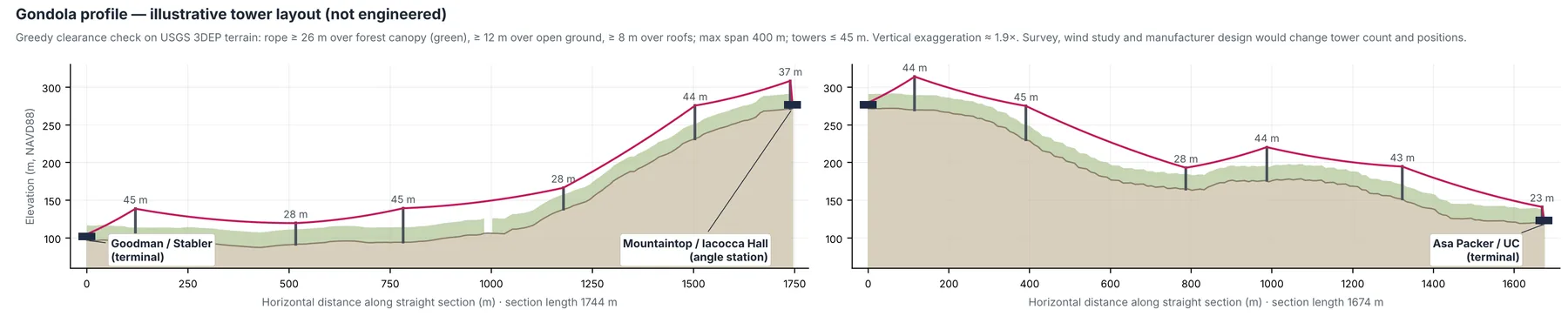
- 2,000–3,000 per hour per direction planning range; 3,600 at Awana SkyWay; Leitner advertises up to 4,500
- Criterion
- Accessibility
- Electric bus on mountain roads
- Level boarding at platforms; ramps
- Gondola (monocable detachable, 8–10 people per cabin)
- Level boarding; cabins creep (~0.25 m/s) or stop fully for wheelchairs, strollers and bikes; station lifts if raised. ADA application to be confirmed
- Criterion
- Weather
- Electric bus on mountain roads
- Snow and ice on 11–13% grades; chains or closures
- Gondola (monocable detachable, 8–10 people per cabin)
- Wind holds at ~50–65 km/h crosswind (monocable); lightning holds; bus backup needed. No South Mountain wind data yet
- Criterion
- Station locations
- Electric bus on mountain roads
- Flexible curbside stops anywhere on the route
- Gondola (monocable detachable, 8–10 people per cabin)
- Three fixed stations on straight lines; illustrative sites next to Stabler Arena, Iacocca Hall and the University Center
- Criterion
- Capital
- Electric bus on mountain roads
- Low (stops, chargers, vehicles)
- Gondola (monocable detachable, 8–10 people per cabin)
- ~$0.05–0.35B (low confidence). Precedents, not like-for-like: Toulouse Téléo (3S) €82M, ~3 km, 2022; Portland Aerial Tram $57M, ~1 km, 2006; Brest €19M, 420 m, 2016
- Criterion
- Operations
- Electric bus on mountain roads
- Part of Phase 1 BRT operating cost; drivers needed
- Gondola (monocable detachable, 8–10 people per cabin)
- Precedents: Portland ~$0.9–1.7M/yr (year unverified); San Francisco's Laguna Honda study ~$2M/yr and not recommended (2026)
- Criterion
- Environment & neighbors
- Electric bus on mountain roads
- No new structures
- Gondola (monocable detachable, 8–10 people per cabin)
- ~12 towers up to ~45 m (illustrative) over forest and campus; privacy and Forest Park / Lost Forest impacts to assess
- Criterion
- Safety & regulation
- Electric bus on mountain roads
- Standard bus practice
- Gondola (monocable detachable, 8–10 people per cabin)
- ANSI B77.1. Pennsylvania's tramway rules (34 Pa. Code Ch. 7, Subch. M) are scoped to recreation — the regulatory path for urban transit is unresolved; an evacuation plan is required
- Criterion
- Resilience
- Electric bus on mountain roads
- Shares roads with traffic and winter conditions
- Gondola (monocable detachable, 8–10 people per cabin)
- Independent of roads, traffic and ice
Verdict for study
Sources: Leitner product data; Awana SkyWay; POMA (Medellín Line K); TU Wien wind study; ANSI B77.1; NY Code Rule 32; 34 Pa. Code Ch. 7 Subch. M; Portland Aerial Tram; SFCTA Laguna Honda study (2026-07-28). Retrieved 17 Oct 2026.